
Author: Site Editor Publish Time: 2026-06-15 Origin: Site


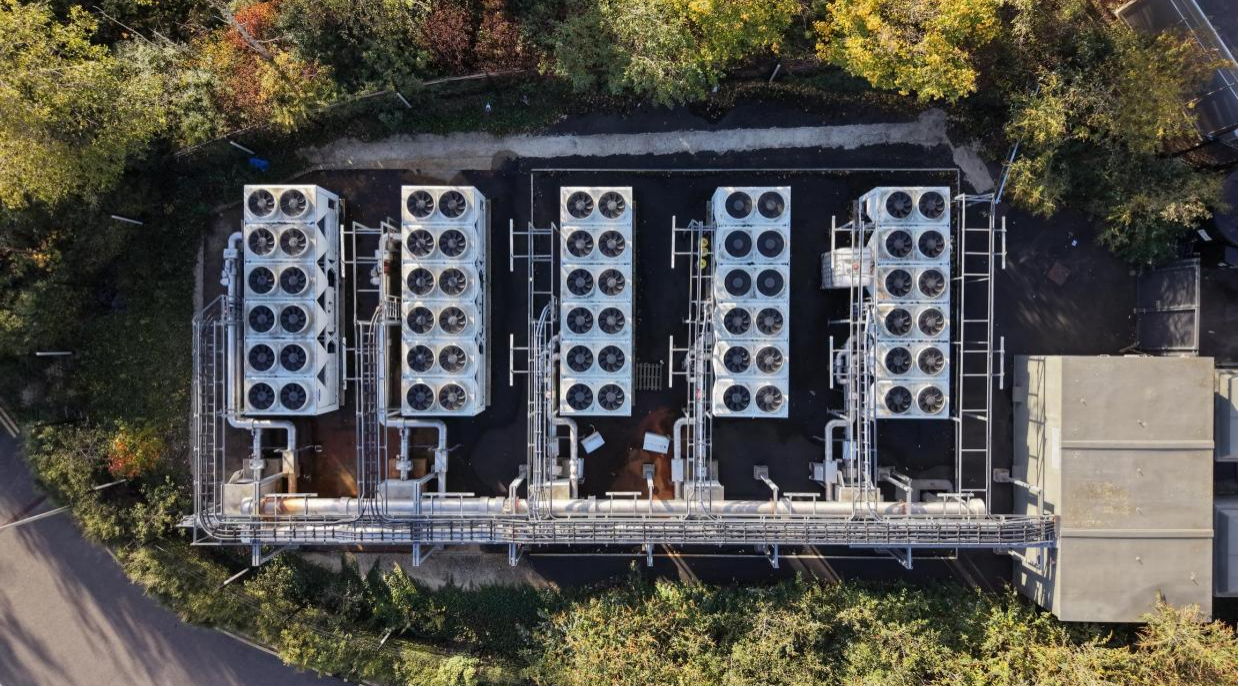
Industrial dry coolers supporting high-density AI data center cooling systems
Artificial Intelligence is transforming data center infrastructure at an unprecedented pace. Traditional enterprise data centers were typically designed for rack densities of 5–15 kW. Today, AI clusters powered by GPUs are routinely reaching 30–100 kW per rack, while some next-generation deployments are already planning for even higher densities. As rack power increases, cooling becomes one of the most critical factors affecting reliability, efficiency, and operating costs.
This shift has accelerated the adoption of liquid cooling technologies such as Direct-to-Chip (D2C) cooling and immersion cooling. However, regardless of how heat is removed from the servers themselves, the thermal energy must ultimately be rejected to the outdoor environment.
This is where dry coolers play a vital role.
For AI data centers seeking water-efficient, scalable, and sustainable cooling infrastructure, dry coolers have become a key component of modern heat rejection systems.

Industrial dry coolers installed at a modern AI data center facility.
A dry cooler is an air-cooled heat rejection system that transfers heat from a closed-loop liquid circuit to ambient air without consuming water during normal operation.
Unlike cooling towers, dry coolers:
l Do not require continuous water consumption
l Minimize water treatment costs
l Reduce maintenance requirements
l Eliminate risks associated with water contamination
l Support environmentally sustainable operations
In AI data centers, dry coolers are commonly integrated with:
l Direct-to-Chip liquid cooling systems
l Coolant Distribution Units (CDUs)
l Rear Door Heat Exchangers (RDHx)
l Hybrid cooling architectures
l Free cooling systems
Many new AI data centers are being developed in regions facing water scarcity concerns. Water usage has become an important environmental and operational consideration for hyperscale operators. Recent industry reports show growing emphasis on closed-loop cooling systems that significantly reduce water consumption.
Because dry coolers operate without evaporative water loss, they provide a practical solution for operators seeking lower Water Usage Effectiveness (WUE).
As rack densities exceed 30–50 kW, traditional air cooling struggles to manage thermal loads efficiently. Many AI facilities are therefore transitioning toward liquid cooling architectures capable of supporting 100 kW+ racks.
In these systems:
1. Heat is absorbed by coolant directly at the server.
2. The heated coolant flows to a CDU.
3. The CDU transfers heat to a facility water loop.
4. The dry cooler rejects that heat outdoors.
Without an effective dry cooler system, the entire liquid cooling chain cannot operate efficiently.
Typical AI data center cooling architecture with dry cooler heat rejection | AI Servers (GPU Racks) ↓ Direct-to-Chip Cooling ↓ Coolant Distribution Unit (CDU) ↓ Facility Water Loop ↓ Dry Cooler ↓ Ambient Air |
The dry cooler serves as the final heat rejection stage, ensuring stable coolant temperatures and continuous AI workload operation.
Modern dry coolers utilize:
l High-efficiency EC fans
l Optimized fin-and-tube heat exchangers
l Variable speed control systems
l Intelligent monitoring platforms
These technologies enable operators to match cooling capacity with real-time thermal loads, reducing energy consumption.
In many climates, dry coolers can provide significant "free cooling" hours throughout the year.
When outdoor temperatures are sufficiently low, heat can be rejected directly to ambient air without mechanical refrigeration, reducing operational expenditures and improving overall facility efficiency.
AI infrastructure is evolving rapidly.
Data centers often expand from:
Deployment Stage | Rack Density |
Traditional IT | 5–15 kW |
HPC Environment | 20–40 kW |
AI Training Cluster | 50–100 kW+ |
Dry cooler systems can be designed with modular capacity expansion, allowing operators to add cooling capability as AI workloads grow.
Data center designers increasingly favor modular cooling infrastructure because rack densities continue to rise beyond historical design assumptions.
Dry coolers must handle large heat rejection loads generated by GPU clusters.
Important design inputs include:
l Total IT load (MW)
l Coolant flow rate
l Supply water temperature
l Return water temperature
l Ambient design temperature
Many hyperscale facilities operate in regions where summer temperatures exceed 40°C.
To maintain reliable operation under these conditions, dry coolers require:
l Large heat exchange surfaces
l Optimized airflow design
l Corrosion-resistant materials
l Redundant fan configurations
AI workloads often run continuously and support mission-critical applications.
For this reason, data center dry coolers typically incorporate:
l N+1 fan redundancy
l Dual power supplies
l Smart monitoring systems
l Remote diagnostics
l Predictive maintenance capabilities
The growth of AI is fundamentally changing data center cooling design. Industry forecasts indicate continued increases in rack power density, with some future deployments potentially approaching several hundred kilowatts per rack.
As liquid cooling adoption accelerates, demand for high-performance dry coolers, data center dry cooling systems, industrial dry coolers, and AI data center heat rejection solutions will continue to grow.
Manufacturers are already developing:
l Adiabatic dry coolers
l Ultra-high-capacity dry coolers
l Low-noise dry cooler systems
l Intelligent IoT-enabled dry coolers
l Custom dry coolers for hyperscale AI campuses
AI is pushing data center cooling technology beyond the limits of traditional infrastructure. While liquid cooling has become the preferred method for managing high-density GPU servers, dry coolers remain the critical final step in the cooling chain.
By delivering water-free heat rejection, high reliability, energy efficiency, and scalable performance, dry coolers help AI data centers operate sustainably while supporting rack densities of 50 kW, 100 kW, and beyond.
For hyperscale operators, colocation providers, and enterprise AI facilities, investing in advanced dry cooler systems is no longer just an option—it is becoming a core requirement for the next generation of data center cooling infrastructure.


