


As data centers, industrial facilities, and process cooling systems face mounting pressure to reduce water consumption while maintaining thermal performance, the choice between a dry cooler and an adiabatic cooler has become a critical engineering decision. The two technologies share a common backbone—air-cooled heat rejection—but diverge sharply in how they handle peak ambient conditions.
A dry cooler (also called a fluid cooler) rejects heat purely through sensible air-to-fluid heat exchange across finned coils. No water is consumed in the process. Performance is governed by the dry-bulb temperature of the incoming air: the warmer the ambient, the smaller the temperature differential between fluid and air, and the lower the heat rejection capacity.
An adiabatic cooler adds a pre-cooling stage upstream of the coil. Water is evaporated into the incoming air—via wetted pads, high-pressure fogging, or similar systems—which lowers the air temperature before it contacts the coil. Because evaporation cools air toward the wet-bulb temperature, the effective heat rejection capacity is partially decoupled from dry-bulb extremes. The coil itself remains dry; only the incoming air stream is humidified.
The decision hinges on three interlocking variables: climate profile, process fluid temperature, and water availability.
Dry-bulb vs. wet-bulb spread is the first diagnostic. In temperate or oceanic climates—northern Europe, coastal regions—the gap between dry-bulb and wet-bulb temperatures is often modest (5–10°C). Adiabatic pre-cooling provides limited additional capacity in these conditions, making a standard dry cooler the simpler and more cost-effective choice. In hot-dry continental or desert climates—the Middle East, inland North America, southern Europe in summer—wet-bulb depression can exceed 15–25°C, unlocking substantial capacity gains from adiabatic assist.
Fluid leaving temperature (FLT) is the second axis. If the process demands a relatively high fluid return temperature (e.g., 40–45°C or above), a dry cooler can often manage even on warm days, provided the unit is sized with sufficient surface area. If the FLT requirement is tight—35°C or lower—dry cooler performance degrades rapidly above 25–28°C ambient, and adiabatic pre-cooling becomes a thermal necessity rather than an option.
Water consumption and quality is the third constraint. Adiabatic systems consume water only during peak periods, but that consumption must be factored against local water costs, treatment requirements, and regulatory context. In water-stressed regions, the intermittent water use of an adiabatic system must be weighed against the alternatives—oversized dry coolers, or chiller-assisted cooling during peaks.
Both cooler types should be sized against design-point conditions, but the approach differs. For a dry cooler, the sizing dry-bulb is typically the 1% or 2% annual exceedance temperature for the site. For an adiabatic cooler, the designer must also assess the wet-bulb at those same exceedance hours, and verify that the evaporative pre-cooling system can reliably achieve a target approach to wet-bulb (commonly 80–90% effectiveness).
Lifecycle cost modeling should include not just capital and fan energy, but also water cost, chemical treatment, periodic pad replacement or nozzle maintenance, and the energy penalty of any supplemental refrigeration during hours when neither cooler type meets the setpoint unaided.
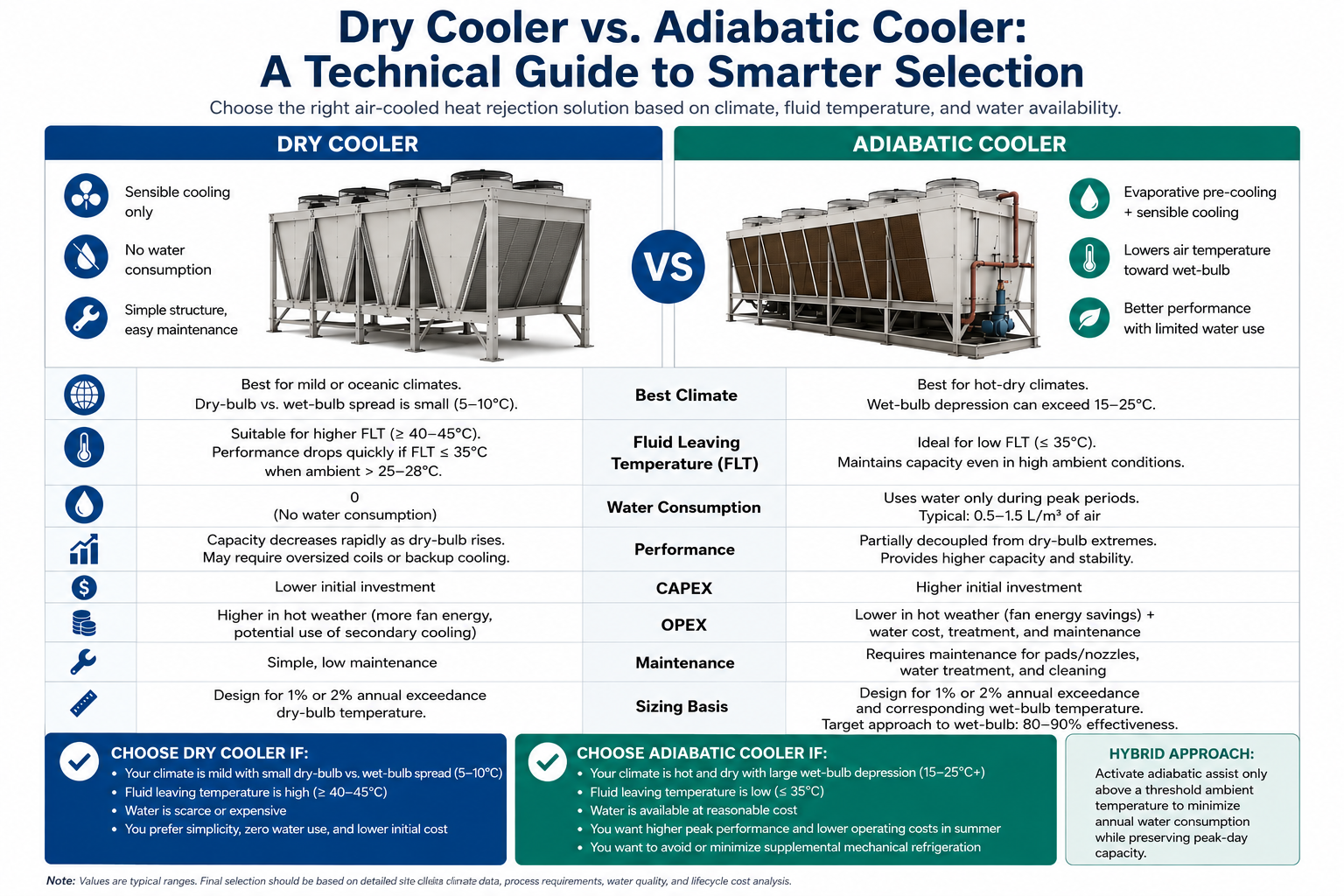
Where ambient conditions are mild and fluid temperatures are moderate, the operational simplicity and zero water consumption of a dry cooler is hard to beat. Where summers are hot and dry, fluid temperatures are low, and water is available at reasonable cost, an adiabatic cooler delivers meaningfully better performance per unit of installed area—often avoiding the need for supplemental mechanical refrigeration entirely. Hybrid approaches, in which adiabatic assist is activated only above a threshold ambient temperature, offer a middle path that minimises annual water consumption while preserving peak-day capacity.


